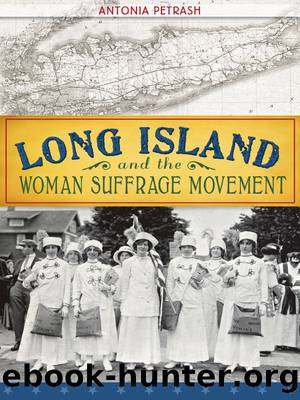
Long Island and the Woman Suffrage Movement by Antonia Petrash
Author:Antonia Petrash
Language: eng
Format: epub
Publisher: Arcadia Publishing
Published: 2013-01-15T00:00:00+00:00
Chapter 7
EDNA BUCKMAN KEARNS
1882â1934
Woman suffrage is bound to come, and the sooner it comes the better for humanity.
âEdna Buckman Kearns
At first glance, the wagon looks a bit frail, certainly not able to carry several people over miles of bumpy Long Island roads, much less the burden of an entire social movement. Its wheels are fragile, its bed is weighted by time and its nickname, the âSpirit of 1776,â is still lightly stenciled on its side, seemingly a touch ironic. It certainly shows it ageâmore than one hundred and fifty years. But neither age nor use have bowed or battered it; instead, it seems endowed with a special strength that will not fade.
Use of the automobile was just emerging in the early part of the twentieth century when this wagon saw its most active days. Thousands of horse-drawn wagons were still in use then, delivering goods, helping farmers with the harvest, carrying the mail and ferrying people about. But this wagon was different. It had a mission that endowed it with the extraordinary spirit of those seeking the simple freedom of political equality. It was altogether fitting that this wagon be dubbed the âSpirit of 1776,â a time when our nation fought for political freedom from England. The women who rode in this wagon, who drove it up and down the dusty roads and country lanes of Long Island, were also seeking political freedomâthe right of women to take full part in their own democracy. For this was, and still is, Edna Kearnsâs Suffrage Wagon.
Edna Buckman Kearns was born in Pennsylvania on December 25, 1882, to Charles Harper Buckman and May Phipps Begley; her brother, Thomas Smith Buckman, was born in 1886. The Buckmans were Quakers (also known as members of the Religious Society of Friends), whose ancestors had arrived in 1682 with the new governor of Pennsylvania, William Penn, seeking freedom from religious persecution. The Quaker faith espouses a sacred respect for all living forms, conscientious objection to war and, especially, the equality of all men and women. The Buckman familyâs faith was evident in the lives they lived: the extended Buckman family acted as conductors in Pennsylvania on the Underground Railroad, helping slaves escape to freedom, and Ednaâs mother, May Begley Buckman, was active in the temperance movement.
Download
This site does not store any files on its server. We only index and link to content provided by other sites. Please contact the content providers to delete copyright contents if any and email us, we'll remove relevant links or contents immediately.
The Secret History by Donna Tartt(19092)
The Social Justice Warrior Handbook by Lisa De Pasquale(12191)
Thirteen Reasons Why by Jay Asher(8912)
This Is How You Lose Her by Junot Diaz(6889)
Weapons of Math Destruction by Cathy O'Neil(6281)
Zero to One by Peter Thiel(5802)
Beartown by Fredrik Backman(5759)
The Myth of the Strong Leader by Archie Brown(5509)
The Fire Next Time by James Baldwin(5449)
How Democracies Die by Steven Levitsky & Daniel Ziblatt(5219)
Promise Me, Dad by Joe Biden(5154)
Stone's Rules by Roger Stone(5088)
A Higher Loyalty: Truth, Lies, and Leadership by James Comey(4964)
100 Deadly Skills by Clint Emerson(4927)
Rise and Kill First by Ronen Bergman(4790)
Secrecy World by Jake Bernstein(4753)
The David Icke Guide to the Global Conspiracy (and how to end it) by David Icke(4720)
The Farm by Tom Rob Smith(4514)
The Doomsday Machine by Daniel Ellsberg(4490)
